

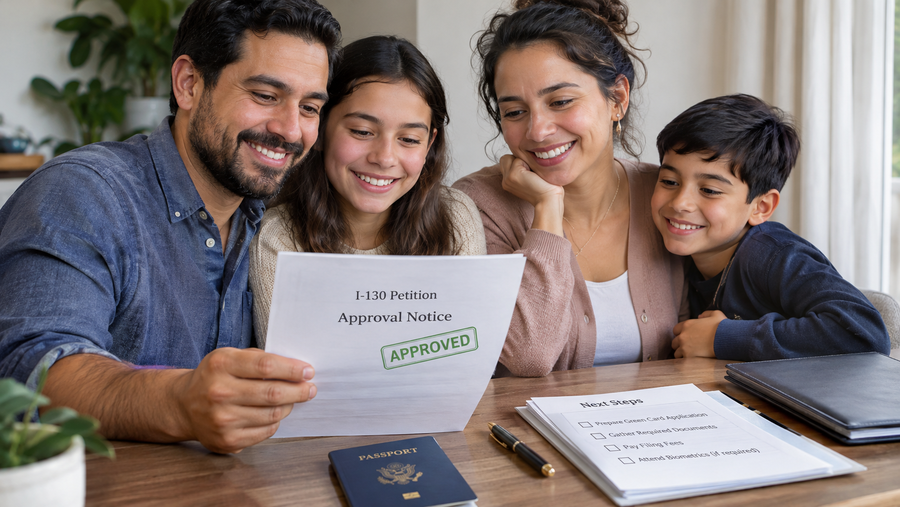
Having your Form I-130 approved is an important milestone in the family-based green card process. After waiting for a decision from U.S. Citizenship and Immigration Services (USCIS), receiving an approval notice can bring relief—and a new set of questions.
What happens after I-130 approval? Can your family member apply for a green card immediately? Will the case be sent to the National Visa Center (NVC)? Is another application required?
The most important thing to understand is that an approved Form I-130 does not automatically grant a green card, lawful immigration status, or permission to work in the United States.
Form I-130 approval generally establishes that USCIS has recognized the qualifying family relationship. The next step depends on the beneficiary’s location, immigration history, family-based visa category, and visa availability.
Some applicants may qualify to apply for adjustment of status inside the United States. Others must continue through the National Visa Center and a U.S. embassy or consulate abroad.
Understanding which process applies can help families prepare the correct documents, avoid preventable delays, and make informed decisions about their immigration options.
What Does Form I-130 Approval Actually Mean?
Form I-130, Petition for Alien Relative, is filed by an eligible U.S. citizen or lawful permanent resident to establish a qualifying family relationship for immigration purposes.
When USCIS approves the petition, it generally means the petitioner has demonstrated the required relationship and petition eligibility.
However, petition approval and green card approval are two separate steps.
An approved I-130 does not, by itself:
-
Grant the beneficiary lawful permanent resident status.
-
Authorize employment in the United States.
-
Provide an immigrant visa or permission to enter the country.
-
Automatically protect someone from deportation.
-
Guarantee that a later green card or immigrant visa application will be approved.
The beneficiary must still complete the appropriate permanent residence process and satisfy applicable eligibility and admissibility requirements.
The official USCIS instructions for Form I-130 explain the petition’s purpose and the distinction between establishing a family relationship and obtaining immigration benefits.
For families wondering about the entire timeline, our guide to family-based green card processing times explains why the petition stage is only one part of the process.
What Happens After I-130 Approval? Start With These Three Checks
Before filing another application or waiting for additional instructions, review three important details.
1. Read Your Form I-797 Approval Notice Carefully
USCIS generally communicates Form I-130 approval through Form I-797, Notice of Action.
Review the notice for the beneficiary’s immigration classification, priority date if applicable, and information about where USCIS has directed or retained the approved petition.
In particular, determine whether the petition is being held by USCIS for possible adjustment of status or has been forwarded to the Department of State for consular processing.
Do not assume that every approved I-130 is automatically sent to the National Visa Center.
The intended process and information provided on the original petition can affect how USCIS handles the approved case.
If the beneficiary’s location or immigration plans have changed since filing, further review may be necessary.
2. Identify Your Family-Based Immigration Category
Whether an immigrant visa is available depends in part on the family relationship and the petitioner’s immigration status.
Immediate relatives of U.S. citizens generally include:
-
Spouses of U.S. citizens.
-
Unmarried children under 21 of U.S. citizens.
-
Parents of U.S. citizens who are at least 21 years old.
Immediate-relative immigrant visas are not subject to the annual numerical limits that apply to family preference categories. However, applicants must still meet the relevant immigration requirements and complete the applicable process.
Family preference categories include certain other relatives, such as spouses and unmarried children of lawful permanent residents, adult sons and daughters of U.S. citizens, and siblings of adult U.S. citizens.
These categories are subject to numerical limits, and applicants may need to wait until an immigrant visa becomes available.
3. Check Whether an Immigrant Visa Is Available
For family preference cases, the priority date generally establishes the petition’s place in the immigrant visa waiting line.
Visa availability depends on the preference category and applicable country-of-chargeability rules.
The U.S. Department of State publishes monthly updates through its Visa Bulletin.
The bulletin contains both Final Action Dates and Dates for Filing. These charts serve different purposes. Applicants seeking adjustment of status must also check which chart USCIS permits them to use for that month.
A petition can be approved even when no immigrant visa number is immediately available.
That distinction is especially important for beneficiaries in family preference categories.
What Happens After I-130 Approval if the Beneficiary Is Outside the United States?
When a beneficiary will obtain an immigrant visa through a U.S. embassy or consulate abroad, the case generally proceeds through consular processing.
After approving the I-130, USCIS normally forwards the petition to the Department of State’s National Visa Center when consular processing is the designated path.
The NVC manages important pre-interview steps, but it does not make the final decision to issue the immigrant visa.
Step 1: The National Visa Center Receives the Approved Petition
After receiving the petition, NVC creates a case in its system and assigns identifying numbers.
When the case is ready for the applicable processing stage, NVC provides a Welcome Letter containing a case number and invoice ID.
Those details allow the applicant to access the Consular Electronic Application Center (CEAC).
For preference-category cases, NVC may hold a petition while the applicant waits for visa availability.
The Department of State explains these procedures in its official NVC processing guide.
Step 2: Pay the Required NVC Fees
Once instructed to begin processing, applicants and petitioners must complete the applicable fee-payment steps through CEAC.
These generally involve the immigrant visa application processing fee and, where required, the Affidavit of Support fee.
Payment requirements and amounts depend on the case and current government rules.
Step 3: Complete Form DS-260
Form DS-260 is the online immigrant visa application used in consular processing.
The applicant provides information about their identity, addresses, family, employment, travel, and other relevant immigration history.
Accuracy matters. Incorrect or inconsistent answers may create complications at the document-review or interview stage.
The Department of State provides official instructions for completing Form DS-260.
Step 4: Submit Financial Sponsorship Documents
Most family-based immigrant visa applicants must have a qualifying financial sponsor.
The petitioner generally completes Form I-864, Affidavit of Support, together with the applicable financial evidence. In some cases, a joint sponsor or qualifying household member may also be involved.
The Affidavit of Support is a legally enforceable commitment. It should not be treated as a simple administrative form.
The Department of State’s Affidavit of Support guidance explains the responsibilities involved.
Step 5: Upload Civil Documents and Supporting Evidence
The applicant must submit the documents required for the particular immigrant visa case.
Depending on the circumstances, these may include birth certificates, marriage certificates, divorce decrees, police certificates, passport information, and required translations.
Document requirements can vary by country and individual case.
Applicants should follow the official civil-document instructions and review any requests issued through CEAC.
Step 6: Wait for Document Review and Interview Scheduling
Once the required forms, fees, and supporting evidence have been submitted, NVC reviews the case for documentary completeness.
If the case is accepted as documentarily qualified, NVC works with the appropriate U.S. embassy or consulate to arrange an immigrant visa interview when the relevant conditions are met, including visa availability where required.
Being documentarily qualified does not guarantee an immediate interview or visa approval.
The consular officer must still evaluate the application and determine whether the applicant qualifies for the immigrant visa.
J Kelley Law Group assists families with immigrant visa procedures, NVC documentation, and interview preparation. Learn more about our Consular Processing Lawyer services.
Form I-130 Approved While You Are in the United States: Can You File Form I-485?
Potentially, yes. Some beneficiaries who are physically present in the United States may qualify to apply for permanent residence through adjustment of status.
Form I-485, Application to Register Permanent Residence or Adjust Status, is the principal application used for this process.
However, an approved I-130 alone does not establish eligibility for adjustment of status.
USCIS must consider additional requirements, which may include:
-
The applicant’s physical presence in the United States.
-
Whether the applicant was inspected and admitted or paroled, or qualifies under an applicable exception.
-
Whether an immigrant visa is available when required.
-
Applicable adjustment-of-status restrictions.
-
Grounds of inadmissibility and any available exceptions or waivers.
The rules differ depending on the immigration category and individual circumstances.
Do You Have to Wait for I-130 Approval Before Filing Form I-485?
Not always.
Some eligible applicants may file Form I-130 and Form I-485 concurrently when the applicable requirements are met and an immigrant visa is immediately available.
Other applicants may be able to file Form I-485 while a qualifying I-130 remains pending or after the petition is approved, depending on the category, visa availability, and filing rules.
If Form I-485 has already been properly filed, approval of the I-130 does not ordinarily mean the applicant must submit another I-485.
Approval of Form I-130 and approval of Form I-485 remain separate decisions.
What if You Overstayed a Visa or Entered Without Inspection?
These circumstances require particular care.
Certain immediate relatives of U.S. citizens may qualify for adjustment of status despite particular periods of unlawful status or unauthorized employment. However, that does not eliminate other eligibility requirements or grounds of inadmissibility.
Entry without inspection can create additional barriers to adjustment of status, although specific exceptions or other legal provisions may apply.
Importantly, leaving the United States after accruing unlawful presence can trigger three-year or ten-year inadmissibility bars in certain circumstances. Other issues, including prior removal orders and multiple unlawful entries, can also have serious consequences.
Do not assume that traveling abroad for a consular interview will resolve an immigration-status problem.
If your case involves an overstay, entry without inspection, previous removal, or another immigration complication, consider obtaining individualized legal advice before filing or departing the United States.
Our Adjustment of Status Lawyer page explains how J Kelley Law Group helps eligible applicants understand Form I-485 requirements and prepare for the USCIS process.
For a comparison of the two procedures, read Adjustment of Status vs. Consular Processing for a Family-Based Green Card.
What if Your I-130 Is Approved but You Have Not Received an NVC Welcome Letter?
Not receiving an NVC email immediately after approval does not necessarily mean something is wrong.
The first question is whether the petition was actually forwarded for consular processing.
Review your I-797 approval notice and any subsequent USCIS correspondence.
If the petition was forwarded to NVC, allow for case creation and review the Department of State’s published NVC timeframes.
If sufficient time has passed, use the appropriate official inquiry channel to request information.
However, when USCIS retained the petition for adjustment of status because of the information originally provided, NVC may not have a case to process.
In certain circumstances, the petitioner may need to request that USCIS transfer the approved petition using Form I-824, Application for Action on an Approved Application or Petition.
Whether that step is appropriate depends on the case’s history and the intended immigration process.
Filing unnecessary applications can increase costs and create avoidable delays.
How Long After I-130 Approval Does It Take to Get a Green Card?
There is no single processing timeline that applies to every approved family-based petition.
Several factors affect the time remaining before permanent residence may be granted.
Family Preference Category and Visa Availability
Applicants in numerically limited family preference categories may face an additional wait even after USCIS approves Form I-130.
That waiting period is tied to the applicable priority date and visa availability.
Immediate relatives of U.S. citizens are treated differently for numerical visa availability, although their applications still require government processing.
Adjustment of Status Processing
For applicants filing Form I-485, the timeline can depend on the USCIS office or processing location, background checks, application completeness, interview requirements, and other case-specific considerations.
National Visa Center and Consular Processing
Cases proceeding through NVC can be affected by document review, requests for corrections, visa availability, and appointment capacity at the relevant embassy or consulate.
An NVC case being documentarily qualified does not establish a specific interview date.
For more information on the factors that influence family-based immigration timelines, visit our article on family-based green card processing times.
Published processing estimates are useful for planning, but they should not be interpreted as promises regarding an individual application.
Common Mistakes to Avoid After Form I-130 Approval
Receiving an approval notice is positive news, but the next actions can have significant immigration consequences.
Some common mistakes include:
-
Assuming the approval is a green card. The beneficiary must still complete the applicable immigrant visa or adjustment-of-status process.
-
Filing the wrong application. Form I-485 and Form DS-260 are used for different immigration procedures.
-
Ignoring visa availability. Family preference applicants must understand their priority date and the appropriate Visa Bulletin rules.
-
Missing NVC requests or deadlines. Unanswered notices can delay a case and, in certain circumstances, create a risk of termination of immigrant visa registration.
-
Submitting inconsistent information. Differences between earlier filings and later applications may require clarification.
-
Traveling without understanding the consequences. Departure from the United States may affect adjustment eligibility, pending applications, or admissibility.
-
Failing to report important changes. Marriage, divorce, naturalization of a petitioner, a child’s age, or a change in residence may affect the appropriate immigration category or processing route.
Taking time to review the approval notice and identify the correct next step may help avoid unnecessary complications.
When Should You Contact an Immigration Lawyer After I-130 Approval?
Some families proceed through a relatively straightforward process. Others encounter questions that are difficult to resolve through general government instructions.
Consider speaking with an immigration attorney when:
-
You are unsure whether adjustment of status or consular processing applies.
-
Your I-130 was approved, but the case does not appear to have reached the expected government agency.
-
Your family preference category involves a significant wait for visa availability.
-
You have questions about Form I-485 eligibility, Form DS-260, or NVC documents.
-
Your case involves unlawful presence, a previous removal order, immigration violations, or potential inadmissibility.
-
A family relationship or immigration status has changed since the petition was filed.
-
You received a request for additional evidence, a refusal, or another government notice that you do not fully understand.
An immigration attorney can review the actual documents and circumstances to explain which procedures may apply.
No immigration attorney can guarantee visa issuance, green card approval, or faster government processing.
J Kelley Law Group provides immigration guidance for eligible individuals and families navigating adjustment of status, consular processing, and related immigration matters.
Our bilingual team assists clients in English and Spanish, with offices in Montgomery Village, Maryland, and Raleigh, North Carolina, and immigration services available to eligible clients nationwide.
Frequently Asked Questions About I-130 Approval
Is an approved I-130 the same as an approved green card?
No. Form I-130 approval establishes the qualifying family petition, but the beneficiary must still satisfy the requirements for adjustment of status or an immigrant visa before obtaining lawful permanent residence.
What happens after I-130 approval if my spouse lives outside the United States?
The approved petition generally proceeds to the National Visa Center when consular processing is the designated route. Your spouse may then need to complete the applicable NVC requirements and attend an immigrant visa interview at a U.S. embassy or consulate.
Can I apply for Form I-485 after my I-130 is approved?
Possibly. You must meet the applicable adjustment-of-status requirements, including visa availability when required, and other eligibility rules. Approval of the I-130 does not automatically establish eligibility for Form I-485.
Can I work in the United States with an approved I-130?
An approved I-130 does not itself provide employment authorization. Some applicants may qualify for work authorization through a separately available immigration category or a properly filed adjustment-of-status application, subject to the applicable rules.
How long does NVC take after I-130 approval?
There is no guaranteed timeline. NVC must receive and create the case, and additional processing depends on visa availability, required submissions, case review, and other circumstances. Families can consult the Department of State’s current NVC timeframe information.
Do I need to file another petition after I-130 approval?
Not ordinarily just because Form I-130 was approved. However, an additional application, such as Form I-485 or Form DS-260, may be required for the next stage. Other forms may be necessary in particular circumstances.
What if I-130 was approved but my priority date is not current?
An approved petition can remain in a family preference category while the beneficiary waits for immigrant visa availability. Review the applicable monthly Visa Bulletin and follow any instructions from USCIS or NVC.
Can an immigration lawyer help after the I-130 has already been approved?
Yes. An attorney can review the approval notice, evaluate the next available immigration procedure, help prepare required applications and evidence, and address case-specific eligibility concerns.
Form I-130 Approved? Get Guidance From J Kelley Law Group
An approved Form I-130 is an important step toward family-based permanent residence, but it is not the end of the immigration process.
Whether your relative is already in the United States or waiting abroad, the next stage depends on the appropriate immigration pathway, visa availability, and the individual’s eligibility.
Understanding these requirements before submitting additional applications can help your family make informed decisions.
J Kelley Law Group assists individuals and families with immigration matters, including eligibility questions, supporting documentation, adjustment of status, and consular processing.
Explore Our Immigration Legal Services:
-
Adjustment of Status Lawyer — Green Card Applications Inside the United States
-
Consular Processing Lawyer — Immigrant Visa Applications Abroad
If you have received Form I-130 approval and are unsure what comes next, contact J Kelley Law Group to request a consultation.




0 Comments